THE PHILOSOPHY OF THE FREE PERSON
Translated from Uzbek · Original text
THE PHILOSOPHY OF THE FREE PERSON
Foreword
A person who has been given a pen is a person who seeks answers to the questions of society. He occupies himself with solving the problems that torment others. In this sense he is called a thinker. Every writer is obliged to be a thinker.
The next treatise we are setting out to write is neither a scholarly study nor a work of fiction, nor is it journalism or sentimental writing. It does not intend to pour hatred on anyone or to peddle affection to anyone. This work had to be born in these days and nights, in exactly this form and exactly this shape. For it may well be that yesterday no need for it was felt. If its writing is delayed, perhaps it will no longer be relevant. In any case, today the author felt an obligation to write on this subject.
Asking God for help, he hopes to complete it soon.
The subject of the book is a description and analysis of the thoughts, dreams, ways of life, ideas and, in a sense, the beliefs of people today.
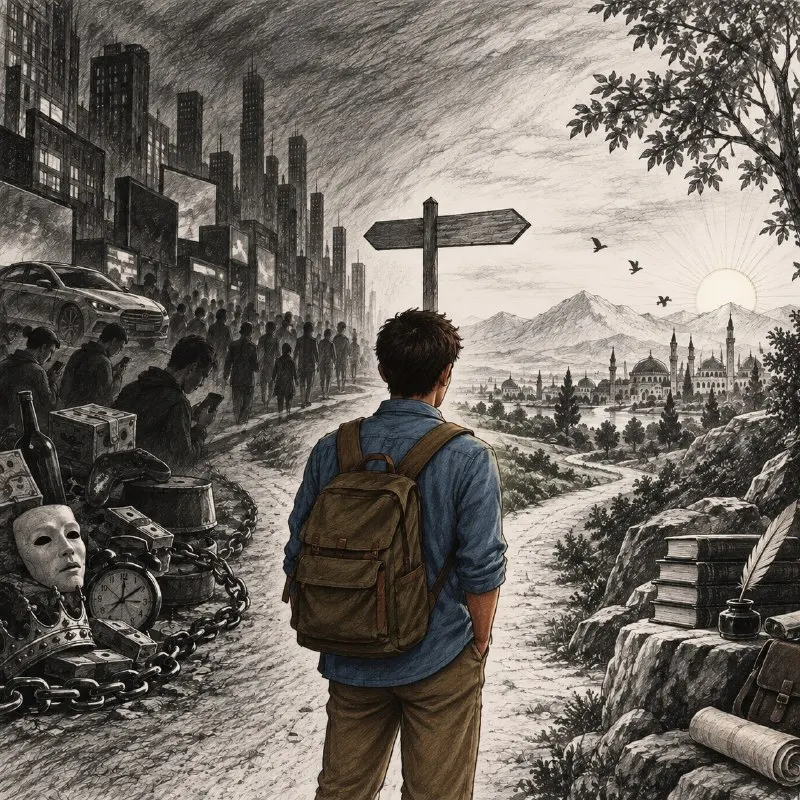
The book calls people to live free. Undoubtedly, one of the most classic of such calls was Aziz al-Din Nasafi’s “The Book of the Perfect Man.” Later, in the West too, there were attempts to free man from various vises. Yet the goal still seems unrealized — the people modeled by the West, thinking they would become free, seem to have fallen captive to depression, dreary pleasure-seeking and unrestraint. They seem to want to drag everyone into this dungeon.
The book focuses mostly on today’s intellectual processes in Uzbek society. The aim is to cover all strata as far as possible. Where this is impossible, attention is given to the ideas with the greatest influence.
In the course of the description, specific individuals or groups may not be mentioned. This is simply the author’s choice.
Whether older readers will find the book interesting or not is unknown, but it is being put on paper mainly to engage young people in thinking. The book does not seek to instill any particular ideology or view.
Rather, it calls every person of reason not to be swept away by the river of processes; it urges them not to sink into the swamp of events, and brings the question of where we are, what we are doing and where we are heading up for discussion down to the last detail. It is very likely that no one will be left out of the discussion. Do not expect partisanship from the author in this discussion. The author spends his strength on standing on the side of justice and truthfulness.
The book brings to the center the intellectual transformations, mostly in our country, during the period from the end of the 20th century AD up to the 26th year of the 21st century. It raises the root causes of today’s turmoil and haste. It speaks of how the spirit and reason are being stolen, and how lust and the nafs, ignorance and vileness are triumphing.
In our opinion, apart from the sophistry that has spun out on YouTube over the last five years, there is no systematic analysis on this subject. As for books, there can be no talk of them yet. For since all the analyses have been political in orientation, the hoped-for goal — the answer to the question of where we are heading and what we are busy with — remains open.
The last lines of our foreword have become personal. So it seems that in some places in the book the author’s personal reflections will also show through; we hope you will read it with this in mind as well. For now, if the first topics of our contents are today’s debates, the spiritual and intellectual context, integration with the West, the pace of progress and the state of people’s souls, then we shall probably go on to speak of the vises that hold man.
Not every word of ours will always be right; we hope that even from mistaken expressions you will grasp the right and true meaning.
We are in need of your prayers; success is from Allah.
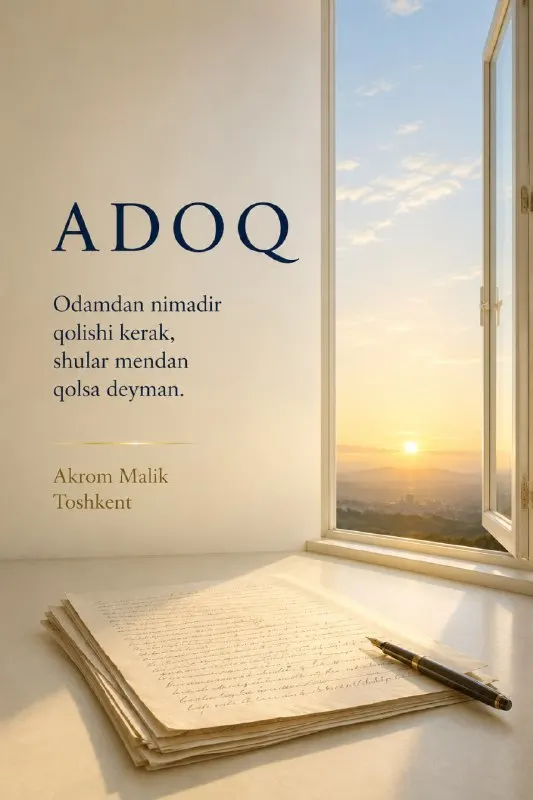
Respectfully, Akrom Malik.
Wednesday evening, September 16, 2026, 21:43. The city of Tashkent.

Comments
No comments yet. Be the first.