Depending on one's life experience and wealth of knowledge, classic texts reveal different facets at…
Translated from Uzbek · Original text
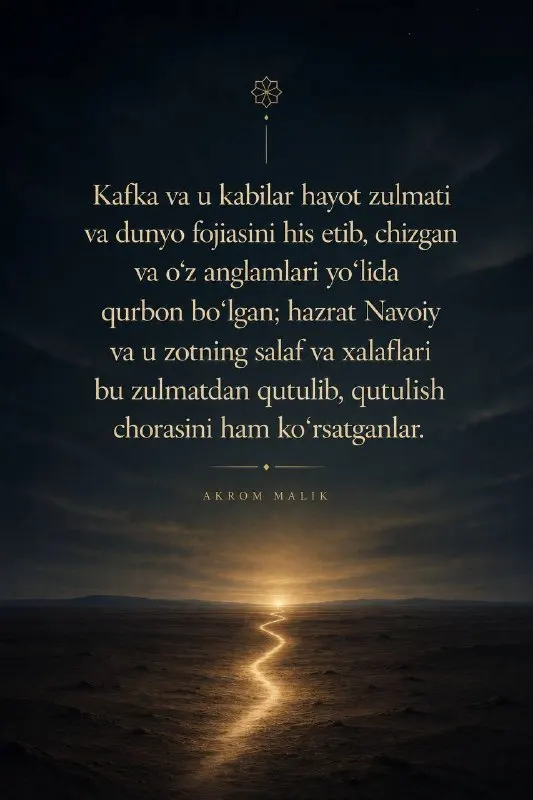
Depending on one's life experience and wealth of knowledge, classic texts reveal different facets at different ages. I finished Kafka's “The Trial.” For some reason, the preface calls the style of the work sluggish and long-winded. On the contrary, I liked it. I looked at the English version. I praised the translator Vafo Fayzulloh. I think the translator, having felt the spirit of the work, managed to render it perfectly in our mother tongue. The author was able to see deeply and illuminate the spirit of society and the human ego, only he saw it as hopeless and in black. He could not find hope and light. Undoubtedly, societies without faith and belief execute their Josef K.s. Those who have seen the true face of society are left with one of two paths: either to consent to execution, or to become one of the people of folly. Just as water that does not flow goes stale, sinking into the swamp of folly means turning into a portion of stinking mud. I think Kafka should be read after drinking water from the spring of Eastern literature. Otherwise, despair takes a person captive. I concluded that Kafka is a great personality. Hemingway too, for example. But Kafka seemed an even greater figure than Hemingway. Unfortunately, he could not fit into a foul environment and perished. In fact, this foul environment is a test for man, and there is a way to come out of it unharmed. One map of this path is in Hazrat Navoi. Now, this is a big matter. For now, put briefly: Kafka and those like him felt the darkness of life and the tragedy of the world, drew it, and fell victim on the path of their own understanding; Hazrat Navoi and his predecessors and successors escaped this darkness and also showed the means of escape. Just as I was about to end my words here, I felt like saying something about “A Farewell to Arms” as well. A delicate, very finely crafted work of fiction. Hemingway is a hot-blooded writer. His words are fiery too. The main character of “A Farewell to Arms” and Josef K. are so alike! But the soldier is taken captive by love; passion lights up his life; otherwise he too would have perished, the darkness would have put him in the noose too. At the end of the work, Catherine died after giving birth. Darkness covered everything for the soldier. No one knows who is to blame. Hemingway writes: no matter how you live, the world will kill you. If you are a hypocrite, slowly; if you are truthful, it takes your life quickly. These words reminded me of what Hazrat Alisher Navoi said about the true face of the world. In “Hayrat ul-Abror” there is a special chapter about this — do take a look. Whether in the East or in the West, thinkers and awakened people perceived the truth of life and the tragedy of the age clearly and plainly, but light and brightness are in the East; this is not partiality — in my view, it is a plain truth. And this is not my humble self's opinion alone. By the way, one word calls up another — the other day the President gave awards to people of art and culture. Everyone was happy. Various opinions were voiced about this event; certain groups discussed the terms ziyoli (member of the intelligentsia) and intellectual. Some traitors, not departing from their repertoire, busied themselves with envy. Apparently, an intellectual is a person who offers solutions to society's problems. Apparently, a ziyoli must bluntly speak out about the injustice he has seen from those in power. In my opinion, neither Kafka nor Hemingway did that, because it is just a very homespun and rustic approach. They understood that the matter is not solved by talking nakedly about oppression and injustice. They strove to see the whole picture of oppression and injustice, then sought its essence; feeling the picture, they drew it; but they did not grasp its essence. They could not solve this riddle. Flattery is one thing; a good word and recognition are another. Flattery is built on greed. A good word and recognition grow out of sincerity. At yesterday's awards ceremony I saw the President's concern — how can I develop the worldview and thinking of the nation and the people — and his dedication and effort on this path. And in response to this effort I witnessed the recognition, sincerity and answer of creative people. Most of the words spoken rang out sincere and full of feeling. The President, too, passed the stage of being carried away by praise long ago. That is why one is surprised that the event is analyzed so crudely and the issue assessed with such blindness; in fact, there is no need to be surprised.
What fruit this movement and reform will bear is another matter — it will become clear in the future; for now, only good hopes are being cherished. The talk began with Kafka, and we also mentioned those who consider themselves the intellectual elite; now two issues are making me think: if I openly state their half-literacy, will I too turn out rustic? They, of course, will not accept it. The second problem — if I say, “You are half-literate,” I would probably be considering myself smarter than them... Now who knows, you say. It also seems better to just say it straight without rambling so much. The word will find its owner.
Akrom MALIK



Comments
No comments yet. Be the first.