Raising children is one of the most fundamental matters in a person's life. Every nation has its own way of…
Translated from Uzbek · Original text
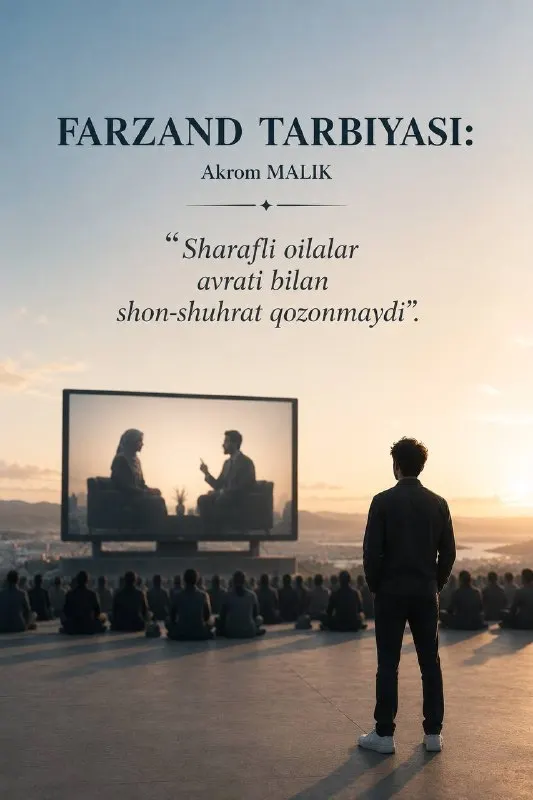
Raising children is one of the most fundamental matters in a person's life. Every nation has its own way of thinking, its own mentality. For the Uzbek people, rules such as modesty, good manners, respect for elders, obedience to the father, compassion for children, not showing off, and in particular not exposing the inner life of the family to public view are very important. For families that have their own ancient roots and traditions passed down from generation to generation — that is, families that received their upbringing from their ancestors and parents — these principles are the most fundamental matter. These are families of mystery and dignity. In these families the father's word is law, his saying is final. The elder brother is the head over the younger. The younger brother obeys the elder. The chief standard of such families is not to follow a broad-minded approach or some outsider beyond the family — whether he lives abroad or holds a high post — so long as he has not earned their trust, and even if he has earned it, and not to imitate strangers in their dealings and relations. In such families new methods of upbringing are not sought; the parents do not rack their brains over how they should treat their child or how they should raise him, because there is the inner rule and model of the lineage, and they simply keep working in that way. Such a family does not put its children on YouTube, does not make a husband-and-wife podcast, does not trumpet holiday gifts to the world, and does not disgrace itself by posting various private matters on social media, whether as a lesson or as a vice. In olden times the Turkic peoples called the family awrat (that which must be covered), and this very word appears in Sayfi Sarayi's book “Turkic Gulistan,” written in 1392. In a word, honorable families do not win fame and glory through what must be kept covered, because what must be covered should stay hidden from the eyes of strangers. It seems that some, having become political refugees and then obtained citizenship, have settled in some foreign country; if, influenced by the mentality there, they use their wives and children to stage educational performances for the public, one must not stand gaping at these theaters or be deceived by them. They are inside the environment and influence of that place. They think on the basis of that place's geography. For them a girl's brazenness is quite natural, whereas with us fathers do not even look their married daughters straight in the eye. With them a son may look at his father and say, “What you did is wrong,” but with us one says, “Very well, Father.” For us a father's heart is a great thing, while it is easy for them to disregard both a father's heart and his dignity. If they promote bad manners in such a gentle guise and covertly strike at the old morality with oily words, shall we sit and watch in silence? Teaching the people inside the country about the family while standing on the outside is a spiritual attack. They have no right whatsoever to build the inner spirit and form of our family for us. Let them kindly come and live in the Homeland, let them taste the bitter and the sweet together with the people, let them do some good for people here, let them show and prove to everyone what good people they are; then we shall see whether such people have the right to speak or not! The very same applies to the traitors who have made themselves into a political opposition. And likewise to certain websites and news sources. This is the approach and conclusion of this humble servant. If you entrust the upbringing of your family to such people, that is your choice. If not, and you want to know whom to ask for a remedy, first of all take advice from the elders of your family; if there are no such people, ask for guidance from learned, pious, trustworthy people in your neighborhood, especially from imams who are people of knowledge — not from the falsely gentle sheikhs and sheikhas on the internet.
Akrom MALIK
Comments
No comments yet. Be the first.