So, Comrades, What Happens If Everyone Pulls the Quilt Toward Himself?
Translated from Uzbek · Original text
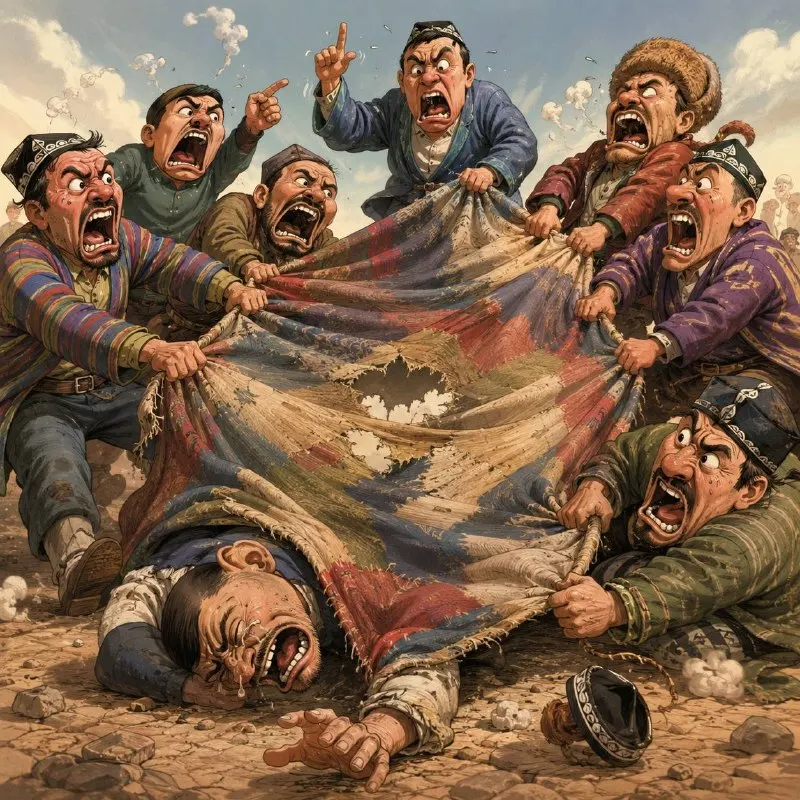
The literary language is a factor that unites the people. For the country is large, and people speak in a wide variety of dialects. Dialects are the wealth of a language, but a dialect reflects the characteristics of the people living in a particular area; that is, the temperament and way of life of the people, as well as geographical features and customs, are reflected in the dialect.
What happens if everyone speaks in their own dialect? First of all, the particular freshness of the dialects is lost. The reason is that as you constantly talk with a person who speaks the Tashkent dialect, you replace the words of your own dialect with words of that dialect and also lose the pronunciation of sounds, which means you begin to pronounce the sounds the Tashkent way too.
In the dialects, sounds shimmer in different ways, everything has names that differ from those in other dialects, and all of this is the wealth of the language's vocabulary and phonetics.
The literary language is a language that has been nourished to a certain degree by all the dialects, formed artificially, understandable to all the people, and at the same time protecting the dialects. Its vocabulary, phonetics and sentence structure are organized on the basis of the dialect of the clans that have the largest population in the nation. In this respect, how far they have advanced politically, socially and culturally compared with others in the country is also important.
Whichever clan, whichever region has developed its scholarship, culture, literature and economy, and, most importantly, remains faithful to its historical foundations – its customs and manners – their tongue and their arm will be long, that is, their influence over others grows. People from other regions learn from them how to live more comfortably, learn new things, manners, morals and knowledge, and so on.
In the first quarter of Independence, almost all the characters in films spoke the Tashkent way. Some leaders, too, spoke in dialect because they were unaware of the rules of the literary language — and it is still so today. And now, on top of that, in the world of the internet we can see young people from certain provinces of our country making all kinds of programs in their own dialects.
If we look at it from the standpoint of tolerance, there is nothing bad about it. It is pleasant to listen to another dialect. The delicate point is that the negative side of discussing some problem in a dialect is not felt, yet all books are in the literary language; historical classical texts are in the literary language; and, more interestingly, if a person singles out the name of the region he belongs to on a wide scale, it looks like localism.
Imagine: every province settles in on YouTube and starts making podcasts saying “We are from such-and-such a place.” They say their goal is not localism. But in essence they are simply separating their own place from the geography of the whole country and presenting it apart. That is, a mood of localism, a separatist movement can be felt.
As a result, a mood of “I am better than you, you are beneath me” spreads, unhealthy competition grows, and the heartfelt friendship of the people in the country is undermined. Talking with irritation about someone as being “from such-and-such a place” becomes widespread, and discord grows. (Even as it is, it is often irritating to see grown men and women going about flaunting their own provinces.)
Of course, young people who have received no education, who cannot tell A from B, are unable to understand this, because they think shallowly, and shallowness and lack of discernment are forgivable. But experienced people, those with a little knowledge, who have read at least two books, who have worn out at least one more shirt than others, must understand that it is their duty to warn the ignorant and undiscerning of the consequences of deeds whose end has not been thought through.
At all times every person from every province, every child of the Homeland, whatever nation he belongs to, must think and work from the idea of the integrity of the land, the indivisibility of the country, and the unity of the people. If he wants to highlight the features of some region, or wants to awaken the people of the place where he was born, he must first of all show their honor, on the basis of historical and scholarly documents, as a part of the Homeland, as a part of the people. This can be done through a number of documentaries and books.
Secondly, in the modern world the biographies and achievements of those born and raised in that region must be spread to the world in a worthy manner, and here the most important rule is this – whatever place we come from, we must present ourselves as a part of the country – the new Uzbekistan, ancient Turkestan, glorious Movarounnahr (Transoxiana).
And it is known to all the wise and discerning people of wisdom that there is a great difference between a person who has acquired deep knowledge over several years and a person who has become literate on YouTube or Facebook. A person who has acquired knowledge has a firm creed and solid views; his self-confidence is built upon knowledge and discovery, his works are planned for the long term, and these works are marked by their durability and by the fact that they do not grow old.
The ignoramus raised by social media, “taught” by social media, changes a thousand ways every day. He seeks his path on social media and wants to show people the way from social media; his goal consists in satisfying his lust for fame and glory.
No one ever acquires solid knowledge by means of social media; solid knowledge and purpose are a wealth that is obtained only as a result of systematic study in the presence of a teacher.
Social media is nothing more than the haunt of the common rabble, of mobs that do not think, of herds hungry for spectacle. It is a pulpit used by some to manage the thoughts of those groups, to keep them from becoming vicious, and to instill certain views in them. Social media merely satisfies the brain's addiction to information.
Social media is a place that stirs up the crowd, controls the crowd, deceives the crowd, and convinces the crowd. Those who know their true worth use it to deliver certain messages to the people. But those with an actor's temperament, the fame-seekers, the lustful, the gossips make it their home.
To put it simply, social media is not for the noble; it is nothing but a cheap stage for actors who could not play a role in the theater, who could not appear in films, whose diplomas barely exist.
Those who know their own worth repent and return to books, to teachers, and do not put themselves up as goods on the stall of social media.
All of these are personal opinions. We have no intention of influencing anyone; this was written as a reminder.
Akrom MALIK

Comments
No comments yet. Be the first.