CHAPTER EIGHT
Translated from Uzbek · Original text
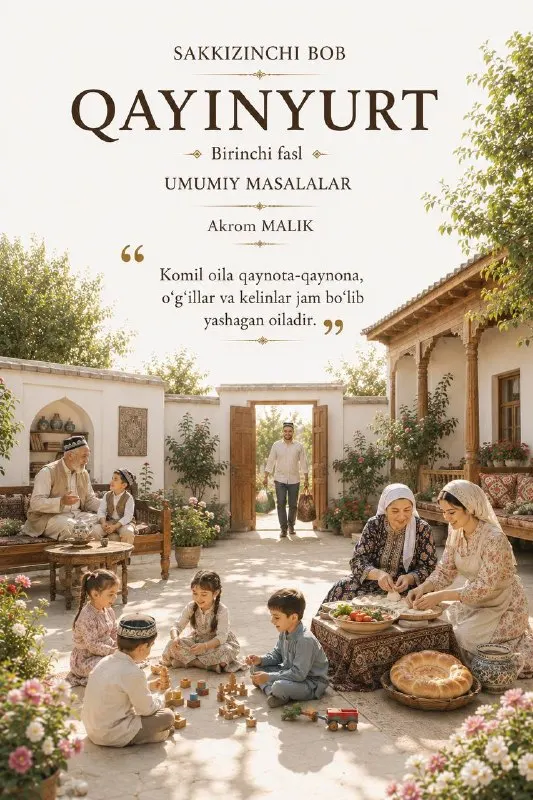
CHAPTER EIGHT
THE IN-LAWS
Section One
General Matters
In the Soviet period, systematic and purposeful work was carried out to smash the old values to pieces. The very first target was the family. If the family is scattered, then the devil will certainly achieve his aim. For this, great effort was put into the following: 1. Separating the child from the parents. If possible, raising the child in a spirit opposed and dismissive toward his parents. To this end, under the slogan “We will give freedom to wives, liberty to the women of the East,” they supposedly “freed them from their chains” and threw them into the fields, worked them like slave girls in factories, made them drive tractors, and killed women by afflicting them with cancer and other incurable diseases. They presented all of this as heroism. While working women who had given birth to death in the fields, they kept their infants in places called nurseries. In fact, as soon as a woman gave birth, they took her baby away separately, mixed the expressed milk of all the mothers and fed it to the babies, thereby even making the infants milk-siblings — sisters and brothers. The infant who did not suckle his own mother's milk grew up motherless in the nursery under cold treatment; orphanages and children's prisons appeared, which had not existed in the time of the khanates; then the child “studied” at school apart from his parents, that is, in autumn and spring the children were sent to the cotton fields as slaves; at school godlessness and, besides that, a number of ideas alien to humanity were instilled, and so on. In this way children gradually became unwilling to submit to their parents. They were portrayed as the knowledgeable ones of the age, and the parents as backward; in particular, these ideas were presented in the foreground in literary works, plays and films. Young people in love with each other were the progressive stratum, and the parents who did not understand them were supposedly ignorant; elements of this can be seen, in particular, in films like “Mahallada duv-duv gap” (“Gossip in the Neighborhood”). 2. Making new families live without a father-in-law and mother-in-law, sowing enmity between bride and mother-in-law, and forming a mood of eternal hostility. This situation was reflected in the play “The Brides' Revolt”; the author approached the matter with great caution, and it seems to me that the great writer showed the attack on values with regret and remorse, with bitter laughter, laughter through tears. In particular, mothers-in-law being called tyrants in the newspapers and their interfering in families' private affairs, all the sons listening to their wives and rebelling against the mothers who raised them, and the pain awakened in the heart of a wise mother like Farmonbibi — a mother who would sacrifice her life for the unity of her family and children — seem to me like a tragedy drawn in the guise of comedy. And in the Azerbaijanis' film “Mother-in-Law,” the mother-in-law being shown as tyrannical and cowardly, being made a fool of by the bride, and so on, was in fact a picture of the old values being uprooted. The details and ideas of these films later recurred in stage works written in the period of independence, such as “Super Mother-in-Law.” 3. Bringing parents and parents-in-law to be indifferent and unconcerned toward their children and brides. In many literary works, for example in plays like “The Medicine of Conscience,” modern parents “respect” the free decisions of their children; but what is noteworthy is that our writers were able to show in various forms how children are left without spiritual support as a result of their parents' upbringing and indifference. The consequences of separating elders from the young under the mask of modernity are not turning out well: as a result of aimlessness, lack of ideals and meaninglessness, people are being seized by deep despondency, sorrow and anxiety; a sound answer to the question of how one should live has vanished from minds; classical forms, in particular a bride living with her mother-in-law, are understood as foolishness and oppression. Yet a bride living in the service of her mother-in-law is an unprecedented, vital system of living.
If, circumstances permitting, the bride were to remain with her mother-in-law until she herself saw grandchildren, the goal would be achieved. This form has the following excellent aspects: 1. The mother-in-law passes on to the bride the experience she has gathered over her lifetime. 2. The bride has a fixed daily routine and masters clear, established rules: waking early; preparing breakfast, lunch and supper for the family; the family gathering to eat at one time; learning the secrets of cooking, cleanliness and sewing from the mother-in-law; having no time left to pester her husband, growing up, looking life straight in the face and gaining wisdom — all of this is acquired in the service of the mother-in-law. 3. The children receive the upbringing of their grandfather and grandmother. Since their hands are largely free of physical labor, they attend to the children's knowledge, enlightenment and worldview. 4. Everyone has an ego, and in particular a woman's ego loves rebellion more; bowing to the mother-in-law trains the bride's ego; finding the way to the mother-in-law's heart becomes a lesson of life for her. The bride learns to go against her ego; even if she does not like the mother-in-law's rule, tomorrow she will see its fruit. A bride with a mother-in-law is a bride of renown; a bride without a mother-in-law is a bride of ridicule. 5. A home with a mother-in-law is a blessed home. When the son gives what he earns to his father, the father and mother agree together on its distribution; this is the best distribution, and money is spent only on necessary things; as a result, the family's savings stay strong. For the father-in-law and mother-in-law, advanced in years, have great financial experience; they do not crave everything; they buy only what is needed, which means surplus money is saved and directed according to a plan to the necessary places — houses are built, carts are bought, and so on. On the whole, several sons and their brides — sisters-in-law — living in one courtyard brings a number of benefits. Usually brides may pester their husbands to death, saying, let's move out on our own. The son, too, may fall for his wife's ruse and, gradually mumbling, obtain his parents' permission to move out. But this is not a very justifiable thing. When the time comes, the parents themselves will say, now move out. Yet living in the embrace of one's parents is the most acceptable solution. Of course, young people who say, let us live separately, let us be independent, also have reasons of their own. Sometimes excesses on the part of the father-in-law and mother-in-law cannot be ruled out. But patience and gratitude are better than everything. Everything gained by separating and moving out is a loss. Everything seemingly lost by living together with the mother-in-law is a gain. If today we want to preserve our offspring, we must return to this fortress. Let everyone in this fortress fulfill his duty. Otherwise we will become prey to the dragon of shamelessness and oppression, rootlessness and despondency that is swallowing the whole face of the earth. To sum up, what we want to say is this: the perfect family is a family in which the father-in-law and mother-in-law, the sons and the brides live together. For this family to be truly perfect, certain moral rules must be followed; we will dwell on them in the following sections.
Akrom MALIK

Comments
No comments yet. Be the first.