CHAPTER EIGHT
Translated from Uzbek · Original text
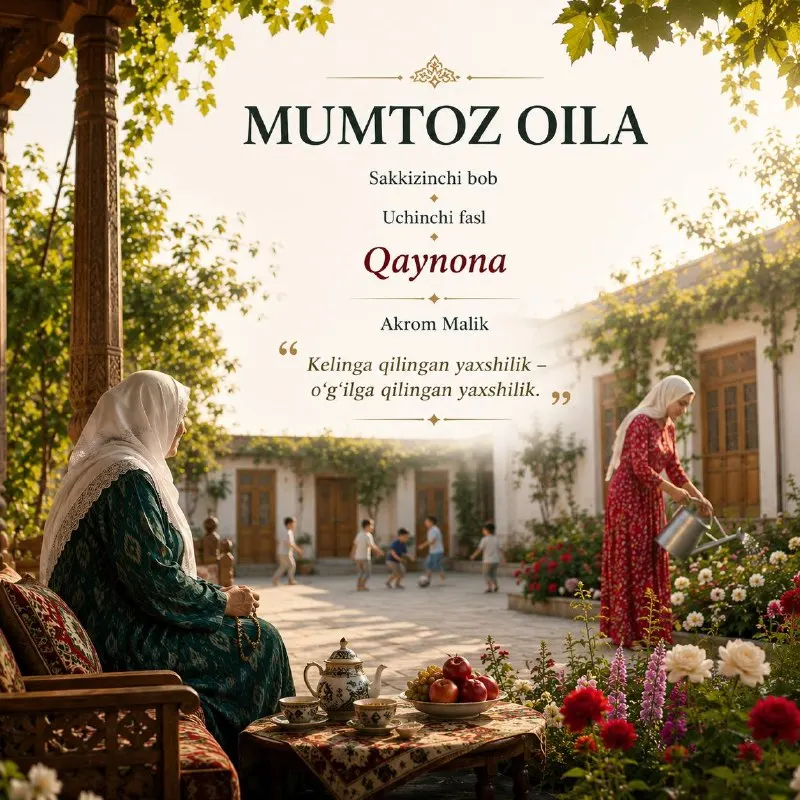
CHAPTER EIGHT
Section Three
The Mother-in-Law
When we say mother-in-law, we are speaking here of the bride's husband's mother; the groom's mother-in-law will be the subject of one of the following sections. Because the mother-in-law is a woman, she is not free of certain shortcomings typical of women, but she has at least 20 years of family life experience behind her. This experience has made the mother-in-law a wise, sensible and bold mother. The mother-in-law is closer to the bride than her own mother. For the mother has given her daughter away in marriage, and the daughter no longer belongs to her; now, until the end of her life, the daughter will be in the service of her mother-in-law, and for her this woman becomes closer than her own mother. The bride is not a daughter; she is closer to the mother-in-law than a daughter. A daughter is in her mother's embrace for 20 years at most, give or take, but if Allah grants life, she receives upbringing at the hands of her mother-in-law for 30–40 years. Naturally, the mother-in-law's place in a girl's life is an extremely important one. When the mother-in-law takes a bride, before the bride enters the house she must work out all the rules of conduct. For this she must set her intention right and look at the bride with impartiality and with eyes of affection and compassion. She regards her as her son's companion. Good done to the bride is good done to the son. Respect shown to the bride is respect shown to the son. The bride's worth is the son's worth. The bride's well-being is the son's peace. Besides, the people's saying holds true: if you want to please your son, praise his wife. Proceeding from this, let the mother-in-law check the intention in her heart again and again: “I will take care of my bride, I will speak kindly to her, I will be just and compassionate toward her.” The mother-in-law is not the bride's girlfriend — this is the main rule. Some, it is said, grow close to the candidate before bringing the bride home; this only does harm. The relationship between mother-in-law and bride differs according to particular periods. A new bride needs serious, calm, gentle treatment. For she has little life experience; she is young, unripe, and it is natural that she will make mistakes. During the first ten years it is proper for the mother-in-law to keep the bride somewhat at a distance; that is, she speaks little with the bride, does not joke with her, does not share secrets with her, does not make barbs and insinuations, does not reprimand her at once for a single fault, but rather warns her twice, firmly and gently, after which she may move on to a reprimand. But before all else she must show how each task is done by doing it herself, because the order in the bride's parental home and the training she received may not be as the mother-in-law wishes and may not match her taste and desires.
Grandchildren are born, the family goes through various events and ceremonies, mourning and festivities — over ten years the mother-in-law and the bride gradually grow dear to each other. The mother-in-law does not immediately show herself in a harsh and angry guise; indeed, there is no need for that. But she unswervingly observes the laws of running a household: the mother-in-law controls the times of sleep — she herself must wake up first; she rises for the Fajr prayer and instructs the bride to do the same; after dhikr and dua comes the morning cleaning of the house and courtyard — in summer water is sprinkled, the yard is swept, the dust is wiped away; in winter snow is shoveled, the rooms are swept, and so on; breakfast is prepared for the family — breakfast is eaten at a flowered dastarkhan with homemade jams and clotted cream, milk and butter, honey and rock sugar, parvarda candies and white sweets, bread and flatbreads, roasted pistachios and almonds, peanuts and walnuts, raisins and dried apricots, hot black tea and green tea. A dua is recited before and after breakfast. Every day must have its plan: after breakfast the grandchildren are sent to school and the men to work. In many village families the women are taken out to work in the fields; if possible, it seems better not to involve women in large-scale hoeing work; if they do such work at home, in the courtyard, and if they themselves wish to, it is of course permissible. From time to time physical labor is a necessity, but work like farming should not be done relying on their strength. The mother-in-law must organize a specific, purposeful task in the household for each day: one day canning jars, one day washing carpets, one day washing quilt covers, one day washing curtains, one day tending the flowers in the courtyard, one day baking bread, and so on. However many brides there are in the household, it is certainly good for them to be kept busy with work. In the interval between the Dhuhr and Asr prayers the brides are given rest. But it is still set at what time they are to come out and what work they are to do. After the evening meal and the Isha prayer, the brides say to the mother-in-law, “Good night, dear Mother!” and go off to the quarters given to them. In the second decade the mother-in-law gives the bride some privileges: she may take her along when visiting and ask her advice on certain family matters. In the third decade the bride is given considerable freedom. But the mother-in-law must never let go of her commanding status. This status is necessary for the strength of the family as well. The mother-in-law must distinguish between the brides according to the ages of her sons — it is good for the wife of the elder son to have a standing that differs in degree from that of the younger son's wife. This is necessary so that the younger ones know their limits and boundaries. The mother-in-law never gossips about her co-in-laws; it is unthinkable for her to say to the bride, “Your father is like this, your mother is like that.” She does not touch the bride's personality or her self-respect. The bride should both be in awe of the mother-in-law and respect her. The mother-in-law must ask the bride for services in such a way that the bride considers serving an honor, and if the mother-in-law does not ask her for anything, the bride feels downcast. The mother-in-law does not argue or shout with the bride; this does serious harm to the morals of the family. Gentleness and a soft word are considered the main standard. A wise mother-in-law never complains about her bride to anyone. Rather, she tries to resolve the shortcomings she finds in the bride with tact and reason. In this matter she does not hurry, and she preserves her dignity. In conclusion, it seems fitting for the mother-in-law to keep a distance from the bride, to speak to her both gently and firmly, to show seriousness and mercy alike, and step by step to raise the bride's standing.
Akrom MALIK


Comments
No comments yet. Be the first.